

The Makers of Siem Reap
The city's strongest workshops combine craft training, paid work and a direct route to the customer.
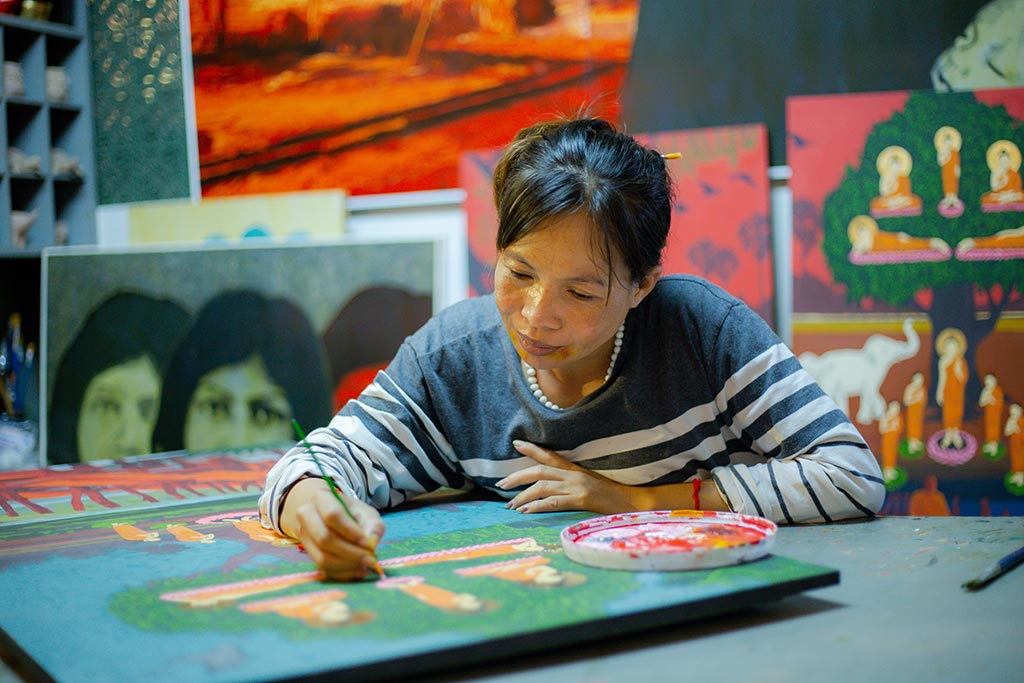
Most visitors come for Angkor and leave without seeing the production network operating beside it. Siem Reap has lacquerers, ceramicists, woodcarvers, textile workers and papier-mâché studios, many of them connected by the same postwar training history. The useful question is not only what they make. It is how the skills are taught, who gets employed and whether the work can support a business.
01. Much of the Industry Started With One Training Program.
Before looking at individual studios, it helps to understand where the workforce came from.
In 1992, Cambodia's Ministry of Education launched Les Chantiers-Écoles de Formation Professionnelle to rebuild vocational skills after decades of war and the destruction of the Khmer Rouge period. The program began with construction trades and expanded into traditional Khmer craft. European funding through REPLIC supported the next stage from 1998 to 2001, and Artisans Angkor emerged as the employer for many of the people being trained. In 2003 it became an autonomous Cambodian company with a model built around reinvestment in training and workshops.
Artisans Angkor now trains young Cambodians in stone, wood, lacquer and silver and operates a large network of silk workshops across Siem Reap province. Its importance goes beyond the products. It created a pool of trained artisans and managers who later moved through other studios or opened their own.
Siem Reap's craft economy was rebuilt through training before it became retail.
That pattern repeats across the city: teach a scarce skill, employ people who have limited access to formal work, then build a product customers will pay for. The studios below use different materials, but most are solving some version of the same problem.
02. Lim Muy Theam Built a Complete Creative Business.
His gallery works because the painting, the architecture, the training and the retail all come from one point of view.
Lim Muy Theam left Cambodia as a child and grew up in France, where he studied fine art in Paris and design at École Boulle. He returned in the 1990s and spent years studying the temples, pagodas, homes and surviving objects that still carried Khmer visual history.
He then spent more than 12 years as technical assistant and artistic director at Artisans Angkor. That experience matters because he helped shape the visual standard of the institution before creating his own. Theam's Gallery, about 10 minutes from Angkor, combines his home, studio, exhibition rooms and traditional pavilions in one site.
The business is stronger than a conventional gallery because it controls the full experience. Theam develops the work, trains apprentices from rural areas and presents the finished pieces inside an environment built around the same visual language. Customers are not only buying a painting or lacquer object. They can see who made it and why it looks the way it does.
03. Eric Stocker Rebuilt a Lacquer Workforce.
The value of the studio is the years of training behind each finished piece.
Cambodian lacquerware almost disappeared, and Eric Stocker played a major role in rebuilding the technique in Siem Reap. The French master lacquerer had worked with Asian lacquer, gilding and polychromy since the 1970s and joined the Chantiers-Écoles program in 1998. He began with 12 apprentices and went on to train roughly 350 Cambodian artisans.
In 2008, Eric and his brother Thierry opened Angkor Artwork, later renamed Stocker Studio, on Wat Bo Road. The studio works with natural lacquer, gold leaf, eggshell, galuchat and straw marquetry. It also employs deaf Cambodian artisans trained through Krousar Thmey.
A lacquer object may look simple on the shelf. The cost sits in the weeks of layering and the years it takes to train the person doing it.
Stocker Studio shows what useful knowledge transfer looks like. The technique was not imported as a finished product or kept inside one foreign expert. It was taught to a local workforce and turned into paid production that can continue without depending on one person forever.
04. Khmer Ceramics Made Inclusion Operational.
The center's deaf instructors are central to the customer experience, not hidden behind it.
Khmer Ceramics & Fine Arts Centre was founded in 2006 to research older Khmer pottery methods and develop contemporary ceramic work. Its social model is unusually practical. The business is woman-owned, about 60 percent of employees are women, and many of the artisans are Deaf or have disabilities.
The key detail is how the classes operate. Three deaf young women teach visitors at the wheel. Because pottery is demonstrated physically, the lack of a shared spoken language matters less than it would in most tourism experiences. The instructors' communication skills became a commercial advantage rather than a problem the business had to work around.
That is the standard for inclusion that matters: the employee's skill improves the product and the customer experience. Visitors pay for a good pottery class, and the business creates stable work at the same time.
05. Jayav Art Turns Waste Paper Into a Premium Product.
The material is inexpensive. The labor and finishing create the value.
Jayav Art began after French artist Philippe Brousseau settled in Siem Reap in 2010 and started working with a Cambodian artist named Tara. In 2011 they opened the Jayav Art House and recruited deaf Cambodian artisans into the workshop.
The studio builds sculptures from recycled newspaper and vegetable fiber over molds, then finishes them with natural pigments and acrylic color. The forms include apsaras, guardians and animals, often with surfaces that look closer to bronze or carved stone than paper. The work received an endorsement from the King of Cambodia in 2018.
Cheap raw material does not mean cheap product. Design, finishing and trained labor are where the value is added.
Jayav is commercially relevant because the environmental and employment stories are built into the production rather than added later for marketing. The recycled paper is the material. Deaf artisans are the workforce. The premium price comes from what they do with both.
06. Satcha Is Training Future Founders.
The older institutions trained employees. Satcha is trying to graduate independent businesses.
Siem Reap still has a limited supply of highly trained artisans. Theam develops apprentices, Stocker trained hundreds and larger institutions run their own programs, but the pipeline remains small. Satcha is the newest attempt to expand it.
Opened in late 2022 and inaugurated in 2023 by B.R.B Cambodia, Satcha describes itself as Cambodia's first handicraft incubation center. It provides workshops, tools, materials and a two-to-three-year program covering craft technique, language, marketing, communication, design and basic business management.
More than 300 people applied for the first intake and about 40 were selected. The campus is open daily and free to visit, so customers can see the training and production instead of only the retail result.
The important shift is from employment to ownership. Satcha does not only want artisans capable of filling jobs in an existing workshop. It wants some of them to leave with enough skill and commercial understanding to start their own companies.
07. The Shared Model Is More Important Than Any One Object.
Across the studios, the same operating logic keeps appearing.
| Maker | Medium | Founded | Model | Who it employs |
|---|---|---|---|---|
| Artisans Angkor | Silk, wood, stone, lacquer | 1992 to 2003 | Semi-public, profit reinvested in training | Rural youth, 18 to 25 |
| Theam's Gallery | Lacquer, wood, silk, painting | Late 1990s onward | Artist-led atelier and apprenticeship | Countryside apprentices |
| Stocker Studio | Natural lacquer, gilding, eggshell | 2008 | Master-and-apprentice workshop | Cambodian artisans, incl. deaf |
| Khmer Ceramics | Ceramics | 2006 | Woman-owned social enterprise | ~60% women, majority deaf |
| Jayav Art | Recycled papier-mache | 2010 to 2011 | Eco social enterprise | Deaf Cambodians |
| Satcha | Mixed handicraft | 2023 | Incubator and training center | Selected trainee artisans |
Most combine a master craftsperson with local apprentices. Many employ deaf or otherwise disadvantaged Cambodians because the work rewards focus, repetition and visual precision. Nearly all depend on direct retail or tourism to pay for skills that would be difficult to support through anonymous factory work.
Siem Reap became a maker city because people invested in training, not because a tourism campaign declared it one.
The lacquer, ceramics and sculpture are the visible output. The larger achievement is the workforce behind them. A city that lost much of its skilled generation has spent 30 years rebuilding one through schools, workshops and paid production. Anyone selling Cambodian design should explain that chain honestly and make sure the people inside it receive more than a decorative credit.
Sources
- Theam's Gallery, About Theam: Lim Muy Theam biography, France exile, École Boulle training, Artisans Angkor tenure.
- Theam's Gallery, official site: home, atelier, and art walk description, daily hours.
- Khmer Ceramics and Fine Arts Centre, official site: woman-owned enterprise, founding, mission.
- Cambodianess, Khmer Ceramics: deaf staff, women employment, teaching model.
- Jayav Art, official site: recycled papier-mache process and studio mission.
- Jayav Art, Papier Mache Art: 2010 to 2011 founding by Philippe Brousseau and Tara, deaf workforce, royal endorsement.
- Stocker Studio, official site: French master lacquerer, materials, Wat Bo Road atelier.
- Éric Stocker, Wikipedia draft: career since 1974, 1998 EU Chantiers-Ecoles role, ~350 artisans trained, Krousar Thmey deaf artisans.
- Satcha, official site: Cambodian Handicrafts Incubation Center.
- Phnom Penh Post, Siem Reap handicrafts centre launched: 2023 opening, first of its kind, training model, applicant numbers.
- Artisans Angkor, Wikipedia: Chantiers-Ecoles origins, REPLIC funding, 2003 semi-public status, regional employment scale.